

Brew Guides
Chemex Brew Guide: Filter Setup and Starting Recipe
Chemex Coffee: A Clear Plan for a Shared Pot
Fit the correct filter, leave the air channel open and use a measured starting batch. Learn the brewer before chasing a finish time.
Start reading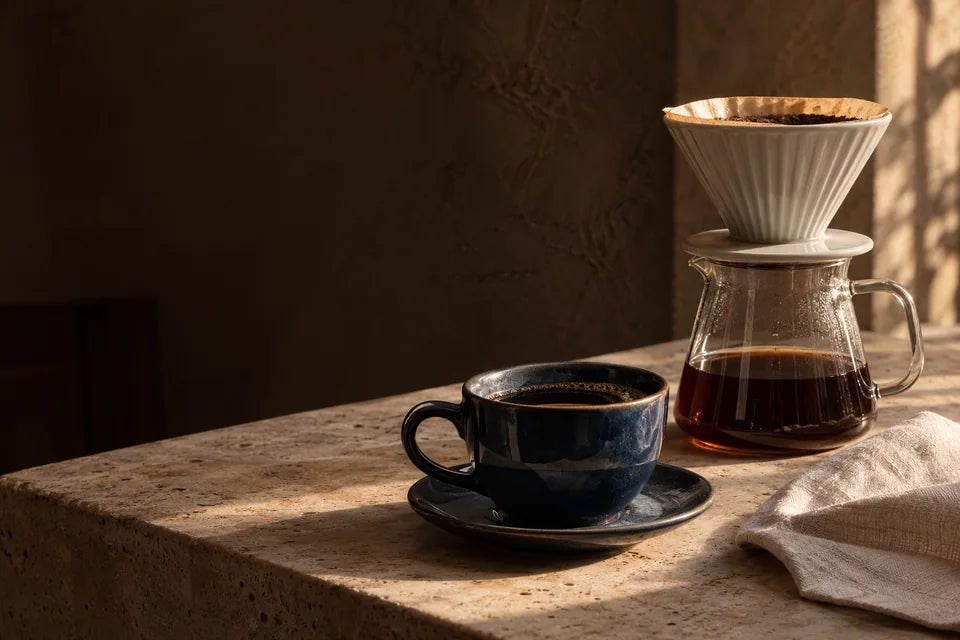 AI-created editorial imagery
In this guide 5 chapters
A simple starting batch
For a CHEMEX large enough for the complete batch, keep our larger Coffee Crate reference: 44 g coffee with 800 g brewing water, ground medium-coarse, using water around 93°C/200°F. The cumulative pours are 90 g, 330 g, 570 g and 800 g. A true half batch uses 22 g coffee, 400 g water and cumulative pours of 45 g, 165 g, 285 g and 400 g.
These are house comparison plans, not CHEMEX-published recipes or tested guarantees of sweetness. The maker supplies the equipment guidance below. A different compatible recipe you enjoy is worth keeping.
Check the actual brewer's working range and compatible filter before starting. The larger reference needs an appropriately sized model. Weighing brewing water does not predict an exact amount in the carafe; wet grounds and paper keep some liquid.
Set up the filter and its air channel
Use the filter specified for your CHEMEX model. With the familiar folded bonded filter, the maker instructs placing the three-layer side over the pouring spout. The spout also serves as an air channel, so the filter must not collapse into and seal it.
Set the brewer on a stable, heat-safe surface and inspect the glass and handle before use. Rinse the filter if its instructions call for it, and discard that rinse water safely before adding coffee. Keep the filter correctly seated as you do so.
Add the coffee and gently level the bed. Set the complete brewer, filter and coffee on a scale that safely supports them, then tare. Leave that assembly on the scale throughout the pours and do not tare between them. The readings then show water added, rather than coffee collected below.
Pour with room to spare
- Wet the bed. Start your timer and pour to 90 g total for the larger batch, or 45 g for the half batch. Aim to wet all the grounds and keep the brewer stable.
- Give it a moment. Wait about 45 seconds for this house plan. The visible bloom is an observation, not a freshness certification.
- Add two manageable pours. For the larger batch, pour to 330 g total, then to 570 g total. For the half batch, the totals are 165 g and 285 g. Let the level fall between pours and leave generous space below the filter rim.
- Finish the brewing water. Pour to 800 g total for the larger batch or 400 g for the half batch. If the level is too high, pause. A clock cue never takes priority over safe capacity.
- Let it drain. Remove the filter safely after the brew, mix the collected coffee and note actual finish time and water amount.
These scale readings include all earlier pours. Do not add them together. Both batch plans use about 1:18.2 coffee to water; halving the ingredients preserves that arithmetic, not an identical drainage time.
For this house starting plan, use water around 93°C/200°F, consistent with the optional temperature reference in CHEMEX’s Brewing 101 instruction brochure. Use a suitable thermometer or temperature-controlled kettle rather than assuming a fixed wait after boiling reaches that temperature. A kettle setting is a target; a reading at the coffee bed is a different measurement. This is a starting choice for the house plan, not a required temperature for every coffee. Follow any limits in the instructions for your actual brewer and kettle.
If drainage surprises you
First check the filter's three-layer orientation and open spout channel. CHEMEX identifies both overly fine grounds and a sealed spout as possible causes of slow filtration. That is a more useful distinction than automatically coarsening every slow brew.
Do not poke, lift or rearrange a hot, full filter to chase a time. Pause pouring if it approaches overflow and handle the brew according to the maker's instructions. Make the safe assembly correction on the next brew.
If fit and capacity are sound but drainage repeatedly restricts, compare a modest coarser grind with the same recipe and pouring. If drainage is unexpectedly fast, verify the intended grind and amounts before considering finer. Record taste alongside time; there is no universal five-minute pass or fail.
A smaller batch may need a different grind or pouring rhythm. Dividing all the ingredient masses by two does not establish that the original schedule or finish time will behave identically.
Find the version you want to share
Paper filtration can give a relatively clear cup with little sediment. Whether you prefer that texture to a French press is personal. It does not make a roast automatically fruitier or promise that every note on the bag will appear.
If the cup tastes too intense, compare a small measured water addition in a portion. If it is sharp, bitter or drying, describe those sensations separately before selecting the next comparison. Our tasting guide helps connect the note with what happened.
Save coffee, filter, grind, actual water, pouring sequence and taste. When the pot is lovely, repeat it. A comfortable shared-batch routine is worth more than changing three things to make the stopwatch look impressive.
Sources & further reading
Our teaching is written for Coffee Crate. Named recipes remain credited to their creators; manufacturer instructions apply to the equipment specified.
- CHEMEX: Frequently Asked Questions (opens in a new tab) ↗Maker guidance: medium-coarse starting grind, three filter layers over the spout and an open air channel; not evidence for an exact house recipe or guaranteed flavor.
- CHEMEX: Getting Started (opens in a new tab) ↗Manufacturer names its cup in five-ounce increments; that convention is not generalized to other makers.
- Hario UK: Expert V60 Brew Guide (opens in a new tab) ↗V60-specific paper-filter equipment and pouring sequence; not a recipe for every dripper.
- CHEMEX: Brewing 101 instruction brochure (2013; distributor-hosted copy) (opens in a new tab) ↗Manufacturer-authored brochure, freshly read October 16, 2026: optional reference of about 200°F. Supports the declared house temperature starting choice only; its universal flavor and boiling-cooldown claims are not adopted.
Sources checked 2026-10-16.