

Brew Guides
French Press vs Pour Over: Which Method Suits Our Roasts?
French Press or Pour Over? Choose Your Morning
Compare texture, attention, serving and cleanup. Either method can make lovely coffee; the better choice is the one that fits your routine.
Start reading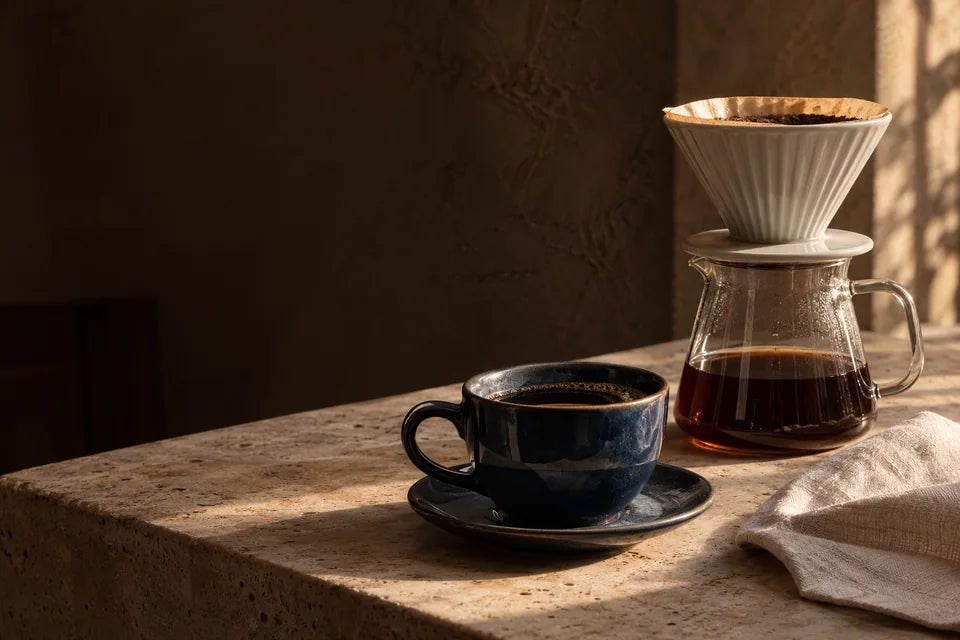 AI-created editorial imagery
In this guide 5 chapters
Start with texture and the time you have
Choose a French press if you enjoy a fuller texture and a routine with a steeping pause. Choose a paper-filtered pour over if you enjoy a clearer cup and want to take part in delivering the water. Neither choice determines which roast you are allowed to enjoy.
If you already own one, start there. A sound recipe on familiar equipment is a better first step than buying the other method to fix a flavor problem that has not been identified.
What changes on the counter?
| Question | French press | Paper-filtered pour over |
|---|---|---|
| How does it brew? | Grounds and water steep together before separation. | Water is poured through the coffee bed and drains into a vessel. |
| What requires attention? | Initial wetting, timing and a safe, gentle plunge or separation. | Controlled pours, water level, filter fit and drainage. |
| What texture might I notice? | A conventional mesh press often gives fuller texture and some sediment. | Paper generally retains more suspended particles, giving a clearer drink. |
| What does cleanup involve? | Removing wet grounds and cleaning the filter assembly. | Disposing of wet grounds and paper safely, then cleaning brewer and server. |
| How much can I make? | The actual press's working range sets the batch. | The dripper, filter and server capacities set the batch. |
These describe common setups. Double-filter presses, metal-filter drippers and immersion-switch brewers can behave differently. Use the instructions for the equipment you actually own.
Keep flavor promises modest
Filtration and brewing behavior influence the cup, but “French press equals chocolate” and “pour over equals fruit” are not recipes. The coffee, roast, water, amounts and technique still matter. Paper can change texture without guaranteeing a named flavor.
Think about your actual drink. If you like milk, compare the finished drinks with the same milk amount. If you drink black coffee, notice whether you prefer a little sediment and weight or a cleaner finish. Neither preference needs defending.
If you dislike unwanted bitterness or sharpness in both methods, switching filters may not answer the whole question. Check actual recipe amounts, care and the coffee itself using the tasting guide.
Choose for your routine as well as your palate
A press can suit a morning when you want a pause between wetting and serving. That pause is not permission to leave hot equipment where it can be knocked over or to forget a step. Follow the press's fill and handling instructions, keep it stable and never force a resistant plunger.
Pour over asks you to be present for the pouring sequence. A small batch can be satisfying when you have that attention available. For several people, a larger compatible dripper and server can work, but scaling a recipe may change drainage and the needed pouring rhythm.
Consider the less glamorous parts too. Do you have a comfortable place to empty a press, filters in the right size and room for a stable kettle and server? A method you can set up and clean easily is more likely to become a pleasant habit.
Try each with its own complete recipe
For a first press, our French press guide offers a capacity-checked Coffee Crate starting plan. For a compatible V60, our pour over guide follows Lance Hedrick's credited 20 g/340 g recipe. Keep each recipe's amounts and method together instead of combining the filter from one with the grind and timing from the other.
If you compare them with the same coffee, note that you are comparing two complete recipes as well as two methods. Different ratios, grind, filtration and recovered beverage amounts all affect the result. It is an enjoyment comparison, not a controlled experiment proving which brewer extracts better.
Write one sentence after each: “I prefer the press's texture with breakfast,” or “The paper-filtered cup is the one I want black.” Then choose the routine you look forward to. The other method can remain an occasional change of pace.
Sources & further reading
Our teaching is written for Coffee Crate. Named recipes remain credited to their creators; manufacturer instructions apply to the equipment specified.
- ESPRO: French Press Brew Guide (opens in a new tab) ↗Named double-filter press preparation; generic mesh presses may differ.
- Hario UK: Expert V60 Brew Guide (opens in a new tab) ↗V60-specific paper-filter equipment and pouring sequence; not a recipe for every dripper.
- CHEMEX: Frequently Asked Questions (opens in a new tab) ↗Maker guidance: medium-coarse starting grind, three filter layers over the spout and an open air channel; not evidence for an exact house recipe or guaranteed flavor.
- World Coffee Research: Sensory Lexicon (opens in a new tab) ↗Research vocabulary for taste, aroma and mouthfeel; not a taste-to-grind diagnosis. No lexicon artwork or reference recipes reproduced.
Sources checked 2026-10-16.