

Brew Guides
How Much Coffee Per Cup? Grams, Tablespoons, and Scoops by Batch Size
How Much Coffee Per Cup? Start With the Water
A quick batch table, an honest answer about scoops and a way to measure your own mug without guessing what “cup” means.
Start reading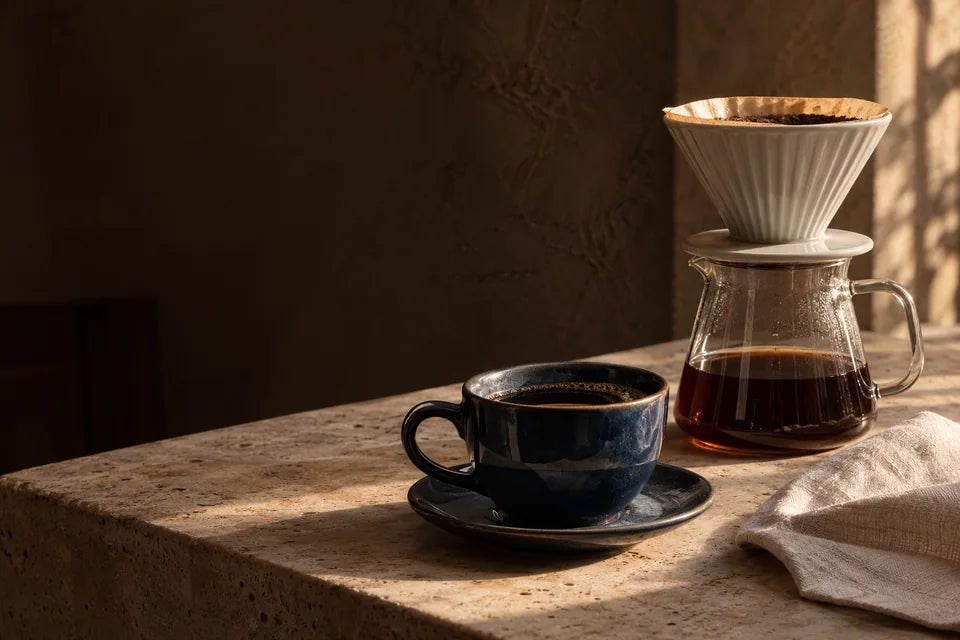 AI-created editorial imagery
In this guide 5 chapters
The useful first number is brewing water
For a straightforward filter-coffee reference, 55 g dry coffee per 1,000 g brewing water gives a place to begin. That is 13.2 g coffee for 240 g water, or 27.5 g for 500 g water. Taste can guide a different recipe later.
This reference follows Moccamaster's published 55 g-per-litre recommendation, expressed here with water weighed in grams for easy planning. It is not a recipe for espresso, Moka pots or every immersion brewer. Our ratio guide explains those distinctions.
The amount in these examples is water you add for brewing. Some stays in the wet grounds and filter, so 240 g brewing water does not promise a 240 g serving.
Choose a batch that fits your brewer
| Brewing water | Coffee at 55 g/kg | Whole-gram option |
|---|---|---|
| 240 g | 13.2 g | 13 g |
| 360 g | 19.8 g | 20 g |
| 500 g | 27.5 g | 28 g |
| 750 g | 41.25 g | 41 g |
| 1,000 g | 55 g | 55 g |
| 1,250 g | 68.75 g | 69 g |
The last column is ordinary rounding for a scale that reads whole grams. Record what you actually use. A usable, repeatable measurement matters more than pretending the scale can read a decimal it does not display.
To calculate another batch, multiply brewing water in grams by 0.055. For 600 g water, that is 33 g coffee. If you know the coffee first, divide its mass by 0.055: 22 g coffee plans 400 g water at this reference.
Your mug and the maker’s cup may differ
A “cup” printed on a brewer is a manufacturer convention, not necessarily a US measuring cup or the mug you drink from. CHEMEX, for example, describes its sizes in five-ounce cup increments. Check your own brewer's actual capacity rather than transferring that convention to every machine.
Fill your favorite mug to a comfortable serving level with cool water, then weigh that water separately. Now you know the serving size you want. Use the brewer's instructions and leave room for grounds and foam when planning the batch; do not fill a brewing vessel to its brim just because a volume calculation says it fits.
For an automatic brewer, fill the correct reservoir with fresh water using a separate clean pitcher as the manufacturer directs. A coffee-stained carafe is an unhelpful measuring vessel for filling the machine. Your initial measured batch and its recovered beverage will teach you how many of your mugs it actually serves.
What if I only have a scoop?
A scoop measures volume, while the recipe asks for coffee mass. Roast, grind, shape of the scoop and how you fill it can change that relationship. There is no exact universal tablespoon conversion.
If a scale is available once, calibrate your own scoop with the coffee you use. Tare a container, add several level scoops and divide their total mass by the number of scoops. For an arithmetic example, if five scoops weigh 50 g, each averaged 10 g in that sample. It does not make every scoop a 10 g measure.
Without a scale, begin with your brewer's scoop instructions and use the same level fill consistently. You can make enjoyable coffee with that routine; simply label the amount as a volume estimate rather than attaching an exact gram claim to it.
Make the next batch a little more yours
If the cup is pleasant but too intense, try a little measured drinking water in a sample before changing the whole recipe. If the drink is pleasant but too light, compare a modestly higher coffee amount next time, within the basket's capacity. Keep grind and the rest of the routine steady.
Adding coffee can also change bed depth and flow, so a strength comparison is not perfectly isolated from brewing. Record the taste and behavior you actually observe. A bitter or sharp cup deserves the more specific checks in our tasting guide.
Once the batch serves the right number of people and tastes good, save the amounts with your brewer and mug size. That small note is the best shortcut on tomorrow's busy morning.
Sources & further reading
Our teaching is written for Coffee Crate. Named recipes remain credited to their creators; manufacturer instructions apply to the equipment specified.
- Moccamaster: Brewing 101 (opens in a new tab) ↗Manufacturer’s 55 g per litre reference and reservoir/filter preparation. It is one brewer reference, not a universal manual-brewing standard.
- CHEMEX: Getting Started (opens in a new tab) ↗Manufacturer names its cup in five-ounce increments; that convention is not generalized to other makers.
- Barista Hustle: Understanding Yield (opens in a new tab) ↗Educator framework for the concentration/extraction tradeoff when changing espresso yield at a fitted dose; not a taste guarantee.
Sources checked 2026-10-16.